
- This event has passed.
Connecting People and Place: Conservation Psychology in Action
OVERVIEW & LOGISTICS
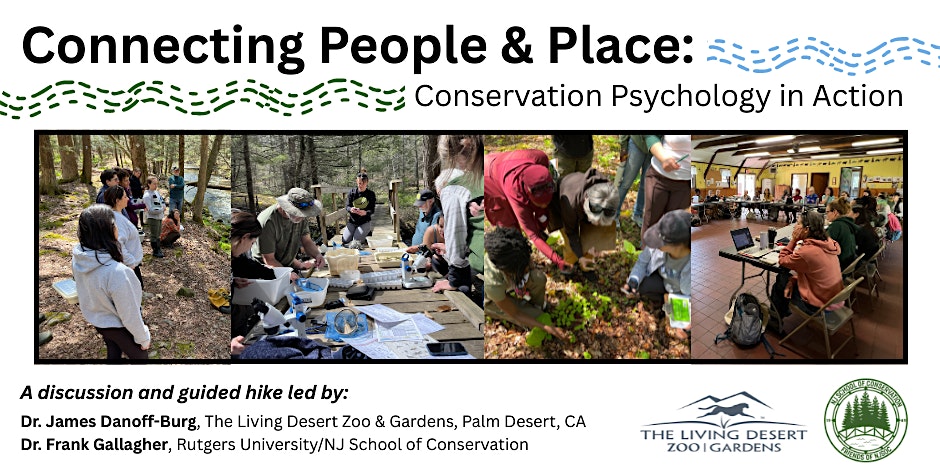
This unique hybrid workshop offers participants the opportunity to engage virtually with the New Jersey School of Conservation in Sandyston, NJ and the The Living Desert Zoo and Gardens in Palm Desert, CA to explore the challenges—and promise—of community-based conservation through the lens of Conservation Psychology. Local people determine the success of conservation projects, so learning from them on how to best engage them in ways that benefit them will make our nature conservation work more successful.
Those who are local to the New Jersey School of Conservation are invited to gather onsite to participate in the Zoom session together, creating a shared learning environment while connecting virtually with partners in Palm Desert and beyond. Please note that the presentation will start promptly at 10:30 AM. You are welcome to check in as early as you like in order to be settled in and ready to go!
Following the Zoom presentation, onsite attendees will take a break for lunch. Please bring your own lunch to enjoy on the grounds as we prepare for the afternoon portion of the workshop.
After lunch, onsite participants will take part in a guided hike on the grounds of the School of Conservation. This immersive, place-based experience will extend the morning’s conversation, using the natural landscape as a living classroom.
By combining virtual dialogue with in-person exploration, this two-part workshop offers both broad connection and grounded experience—linking ideas to action in meaningful and memorable ways.
CONTENT & AGENDA
10:30 AM – 12 Noon
Part I. “Community-Based Conservation: Towards a More Effective Form of Nature Conservation ” (Live Zoom Presentation)
Join us for an engaging and thought-provoking Zoom introduction to Conservation Psychology and how it can best be used to foster effective community-based conservation led by James Danoff-Burg of The Living Desert Zoo and Gardens in Palm Desert.
Conservation Psychology explores the powerful connection between people and the natural world—examining why we care about nature, what motivates environmental action, and how organizations can inspire meaningful, lasting behavior change. Drawing on his extensive experience in conservation education and community engagement as a professor at Columbia University and conservation leader at San Diego Zoo and now The Living Desert Zoo and Gardens, Dr. Danoff-Burg will guide participants through real-world challenges and practical strategies for engaging communities in watershed protection and addressing modern conservation issues such as invasive species and climate change.
Whether you’re an environmental professional, student, educator, volunteer, or simply passionate about protecting our planet, this session will provide valuable insights into how understanding human behavior can strengthen conservation efforts and create deeper, more effective community impact.
12 Noon – 1 PM
Discussion/Lunch (bring your own) for onsite participants at NJSOC
1 PM – 3 PM
Part II. “Layers of the Land” (Guided Hike)
Dr. Frank Gallagher, Director of Research for the SOC and Associate Professor at Rutgers University will guide participants on a hike through the NJSOC property as a living record of human history, beginning with an introduction of how the landscape has been shaped by past use, restoration, and ongoing human connection. The hike connects the work of the Civilian Conservation Corps, emphasizing their role in reforestation and land management, while also touching on watershed protection and modern conservation challenges like invasive species and climate change. Throughout, we will incorporate ideas from Conservation Psychology to encourage reflection on how perceptions of landscapes evolve and influence stewardship, ending with a discussion that invites participants to consider their own role in the forest’s ongoing story.
Don’t miss this opportunity to learn how understanding human behavior can be one of our most powerful conservation tools.
SPEAKERS

DR. JAMES DANOFF-BURG is the Vice President of Conservation at The Living Desert Zoo and Gardens, where he leads the institution’s conservation strategy and global field initiatives.
In his leadership at The Living Desert, Danoff-Burg has become well-known for promoting a broader, socially engaged approach to conservation. He champions programs that combine biological science with social science — including the Building Community Conservation Success (BCCS) workshops and the collaboration with IUCN to create the Center for Behavior Change at The Living Desert— to train conservation practitioners around the world in how best to engage communities as key partners in species protection and ecosystem stewardship. These programs emphasize that long-term biodiversity conservation requires not just habitat and species work but also meaningful involvement with people who live alongside wildlife.
Before his role at The Living Desert, he also served as a Professor at several universities including Columbia University, and led or consulted for multiple conservation-focused organizations, including founding Helping Rhinos USA, a nonprofit dedicated to rhino conservation, the San Diego Zoo, and now The Living Desert Zoo and Gardens. His career reflects both on-the-ground fieldwork and strategic leadership in international and community conservation.
Under his direction, The Living Desert’s conservation efforts span 105 projects in 12 countries across three continents, integrating habitat restoration, endangered species programs, behavior change research, and capacity-building collaborations with field partners.

DR. FRANK GALLAGHER is the Associate Professor of Professional Practice and Director of the Environmental Planning and Design program of Rutgers University’s Department of Landscape Architecture. He is also the New Jersey School of Conservation’s Director of Research, coordinating the school’s academic Research Consortium.
For over forty years, Dr. Gallagher has explored the connection between people and landscape through both land management and academic research. He has served as Chief of Interpretive Services, Administrator and Assistant Director of the New Jersey Division of Parks and Forestry. After teaching courses in biology, evolution and environmental science for ten years at Upsala College, he joined the faculty at Rutgers, The State University part time in 1994, and full time in 2012.
His current appointment as Associate Professor of Professional Practice and the Director of the Environmental Planning and Design program within the Department of Landscape Architecture consists of academic advising, and working with academic administrators, administrative staff and faculty to ensure the continued development and delivery of a cutting edge program. He serves on the graduate faculty for the Department of Landscape Architecture, Department of Ecology Evolution and Natural Resources and the Federated Department of Biological Sciences at Rutgers Newark and also serves as a Research Associate at Montclair State University.
Throughout his career, he has contributed significantly to public land conservation and ecological education, including ecological planning for Liberty State Park and chairing management planning for multiple New Jersey state parks. His efforts have earned recognitions such as the EPA Environmental Quality Award.