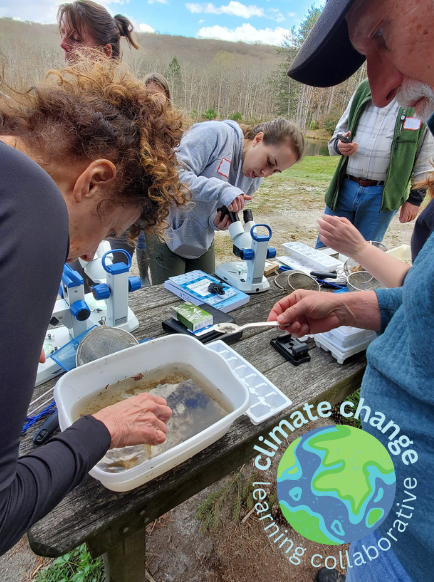
A Unique Learning Opportunity for NJ Public and Charter School Teachers
As educators, you play a crucial role in shaping the next generation’s understanding of climate change. The NJSOC has partnered with Ramapo College on the statewide Climate Change Learning Collaborative grant (CCLC) from the Department of Education to support you on your journey to integrate climate change education into your practice.
Teachers in public and charter schools anywhere in New Jersey (any grade level, any subject) are eligible to participate and will earn $200 upon completion of each workshop attended. Free overnight lodging in cabin style housing at NJSOC is available. Workshop toolkits will be provided.
Contact Tanya Sulikowski, NJSOC Director of Education at tsulikowski@njsoc.org with any questions.
2026-27 Workshop Schedule
*You may still register even if a workshop is listed as FULL. You will be placed on a waiting list and contacted if a space opens up for you.
July 6-7, 2026 or October 16-17, 2026
Strengthening Climate Literacy Through Spotting Fake News | Agenda TBD
Educators will learn practical strategies for identifying misinformation, evaluating sources, and guiding students toward evidence-based understanding of climate science. A highlight of the workshop will be a field-based activity led by a library media specialist, who will send teachers on an interactive “Quest for the Truth.” During this hands-on outdoor challenge, educators will investigate sample news items, trace claims back to their sources, and practice applying critical-thinking frameworks they can later use in their classrooms.
July 7-8, 2026 or September 25-26, 2026
Measuring Biodiversity | Agenda TBD
This workshop introduces educators to hands-on methods for measuring and understanding biodiversity using two powerful open-access tools: iNaturalist and the Biodiversity Heritage Library (BHL). Participants will explore how community science observations and historical biodiversity records can be used together to support climate science research and education.
Through guided activities, educators will learn how to collect, identify, and analyze local species data using iNaturalist, and how to access historical species distribution, taxonomy, and ecological records through BHL. The workshop emphasizes connections between past and present biodiversity data to help students investigate climate-driven changes in ecosystems over time.
August 19-20, 2026 or November 5-6, 2026
Climate-Resilient Design in New Jersey | Agenda TBD
This workshop invites teachers to engage deeply with real-world environmental challenges while discovering strategies they can bring back to their classrooms. In partnership with Rutgers University, teachers will collaborate with Rutgers students on an in-depth study of New Jersey —examining its geography, infrastructure, and unique vulnerabilities—to envision how cities can be redesigned for greater climate change resiliency. Participants will explore how thoughtful, community-centered design can support adaptation and sustainability in coastal communities. The afternoon moves outside to the NJSOC campus, where educators will take part in a hands-on, outdoor design activity that puts the morning’s learning into practice. Working in teams, teachers will apply design-thinking principles to evaluate real environmental features, prototype solutions, and reflect on how place-based, experiential learning can strengthen student engagement.
August 18-19, 2026 or March 12-13, 2027
Wild Sounds | Agenda TBD
Participants will be introduced to innovative ways scientists use sound to collect environmental data. The session will highlight how acoustic monitoring can reveal shifts in species behaviors linked to a warming climate, offering an engaging lens for classroom instruction. One field-based activity will focus on the phenology of wood frog or bird calls, where teachers will learn how changes in the timing and frequency of these early spring vocalizations can serve as indicators of temperature trends and ecosystem health. By combining hands-on data collection with real scientific methods, the workshop will empower educators to bring meaningful, place-based climate science into their curricula.